
Can ChatGPT or Claude replace a calorie counter? What works and what chat forgets
Prompts that get a good calorie estimate from ChatGPT or Claude, how to keep a daily total in a chat, where that breaks, and the apps that keep the log.
You already pay for ChatGPT or Claude. You also pay for a calorie counter, or you’re about to. Can the chat do the job?
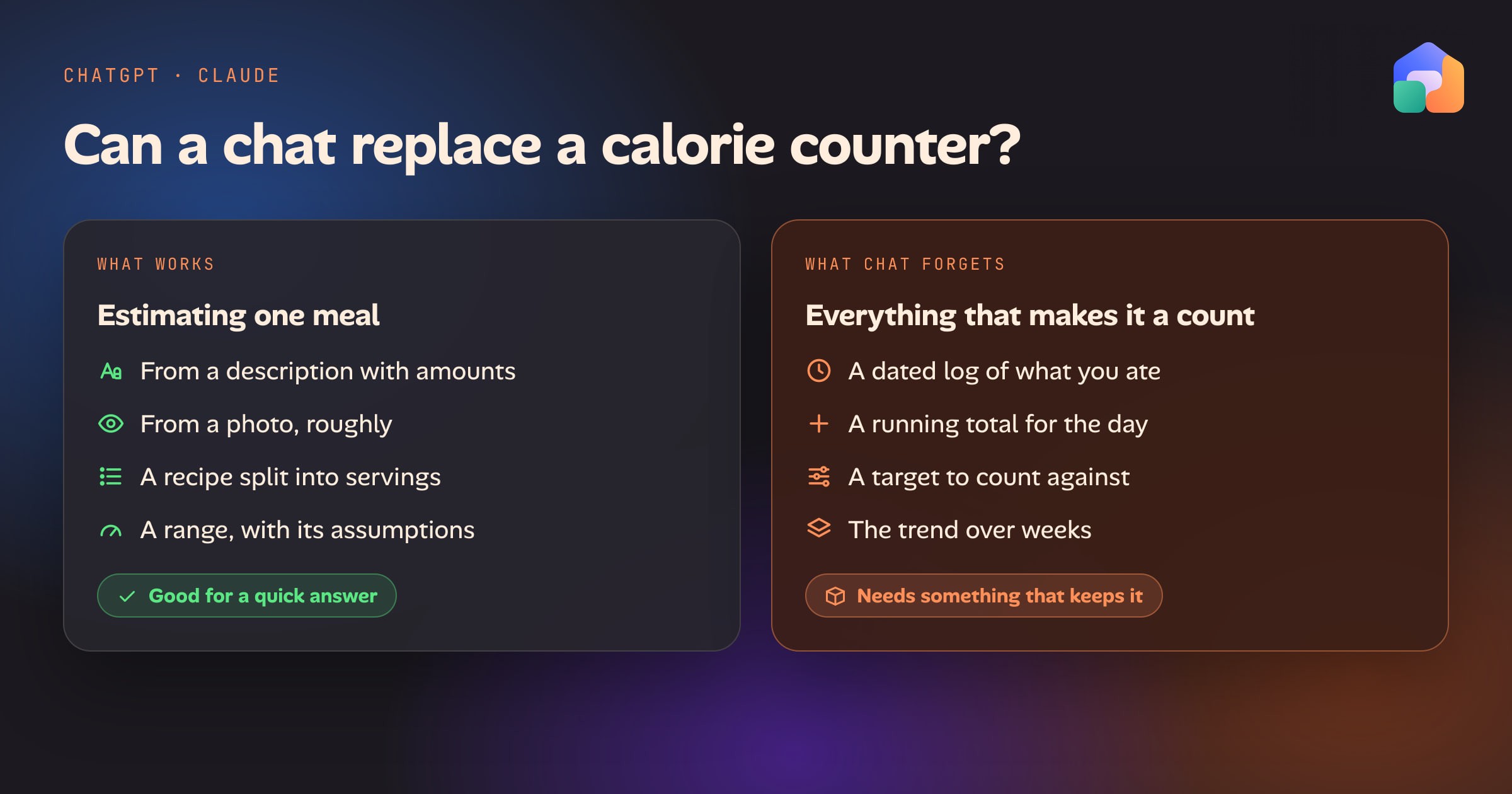
The short answer: a chat is a good estimator and a poor logbook. It will tell you roughly what’s in a meal, from a description or a photo, in a few seconds. It will not reliably keep what you ate, add it up through the day, hold it against a target, or show you the last six weeks. The estimate is the easy part of counting. The record is the part you pay an app for.
This post covers both halves: how to get a good estimate, how far you can push a chat as a tracker, where it breaks, and what to use for the part chat can’t do. It reflects how these products work in October 2026.
One thing first. This is a guide to tools, not to diets. How much you should eat depends on your body, your health and your history, and a chatbot doesn’t know those. If you have a medical condition, are pregnant, or have or have had an eating disorder, talk to a doctor or a registered dietitian before you count anything.
Prompts that estimate a meal well
A model that isn’t told an amount will guess one. Most of the error in a chat estimate comes from what the model had to assume: the portion, the oil, whether the yoghurt was full-fat. Good prompts remove the guesses.
From a description. Give amounts, the cooking method and the fat.
Estimate the calories and protein, carbs and fat for this meal.

- 2 large eggs, scrambled in about 1 teaspoon of butter
- 2 slices of wholemeal toast, each with a thin scrape of butter
- 1 medium banana

Give me a table with one row per ingredient, then a total.
Give the total as a range (low to high) as well as a best guess.
List every assumption you made about amounts.
The last two lines matter most. A range tells you how much to trust the number, and the list of assumptions shows you what to correct. If it assumed a tablespoon of butter and you used a teaspoon, say so and ask it to redo the table.
From a photo. Add what the picture can’t show.
Here is a photo of my dinner. Estimate the calories and macros.

What you can't see: it's chicken thigh with the skin on, cooked in about
1 tablespoon of olive oil. The rice is about 1 cup cooked. The plate is
27 cm across.

Tell me which items you identified, the amount you assumed for each, and
which part of the estimate you are least sure about.
From a recipe. This is where a chat is strongest, because nothing is hidden.
Here is a recipe that makes 6 servings: [paste the ingredient list with amounts]

Work out calories and macros for the whole recipe and per serving.
Show the per-ingredient numbers so I can check them.
For packaged food, skip the estimate. Read the label, or type the label’s numbers in. A printed nutrition panel is better than any model’s guess at it.
How accurate is it?
Three peer-reviewed studies from 2025 tested this directly, and they are the ones the calorie-app blogs lean on. Each tested models that have since been replaced by newer ones, so read the numbers as a guide to the shape of the problem.
- Fridolfsson and colleagues, in Current Developments in Nutrition, gave 52 standardised food photos to ChatGPT-4o, Claude 3.5 Sonnet and Gemini 1.5 Pro. ChatGPT and Claude were each off by 35.8% on calories on average, and Gemini by 64.2%. All three underestimated, and more so as portions got larger.
- O’Hara and colleagues, in Nutrients, found ChatGPT-4 identified the foods in meal photos with 93% precision and judged small portions well, but did poorly on the weight of medium and large portions, and so on the nutrient totals.
- Rodríguez-Jiménez and colleagues, also in Nutrients, tested ChatGPT-5 on 195 dishes and changed how much it was told each time.
The third study is the useful one for anyone writing prompts:
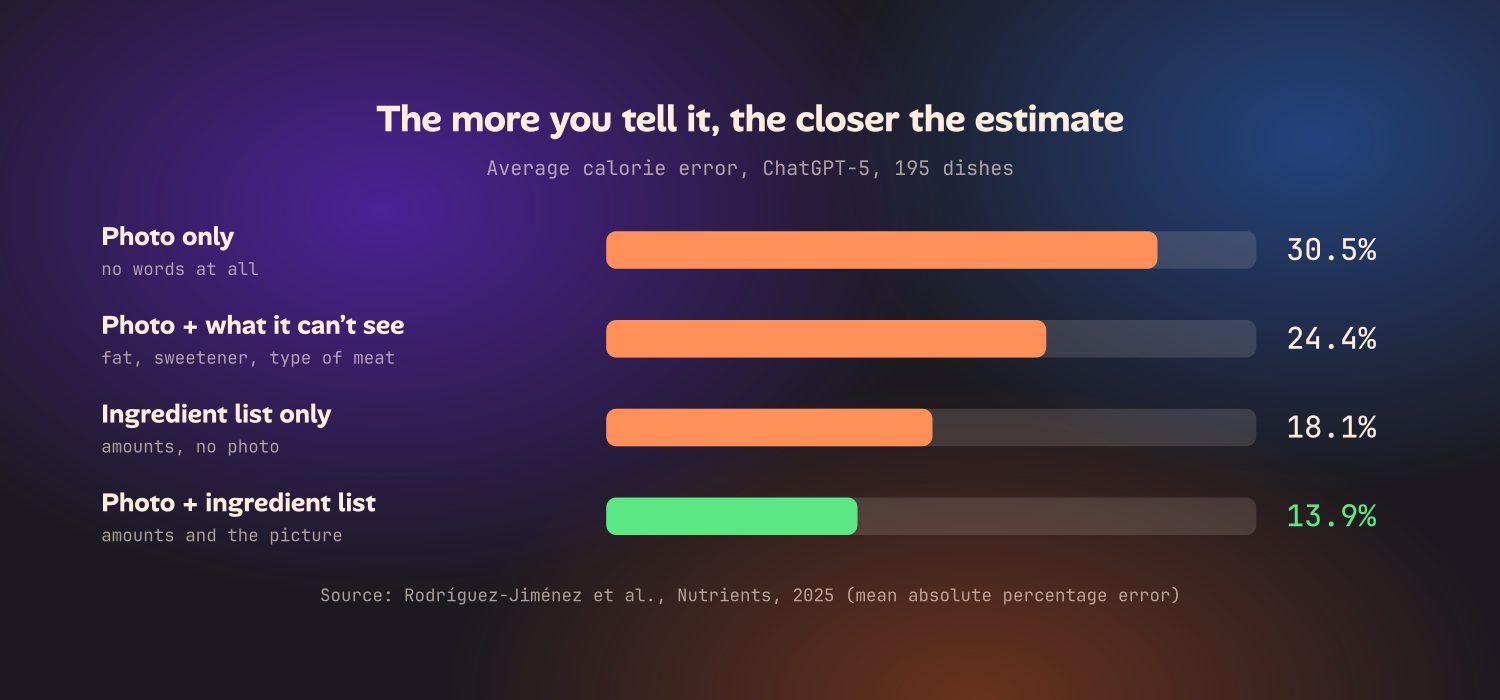
A photo alone was off by about 31% on average. A photo with a detailed ingredient list was off by about 14%. That is the whole case for the prompts above.
Two fair points for the chat. The Fridolfsson paper concludes that ChatGPT and Claude were about as accurate as the traditional ways people report their own eating, with far less effort. It also says they are “not yet suitable for precise dietary assessment in clinical or athletic populations”. Both are true. For a rough idea of a meal, a chat is fine. For a number you’ll base a plan on, it isn’t precise enough from a photo.
The apps make the same case, with an interest in the answer. kcalm’s 2026 review collects these studies. Nutrola’s own test of 54 foods, published in April 2026, put ChatGPT about 18% off on average and Claude about 16%. Cronometer’s argument is that a chat has no verified food database behind it and doesn’t track anything. All three sell a tracker. The peer-reviewed numbers point the same way.
Keeping a running daily total in a chat
You can make a chat behave like a tracker for a while. This is the setup that holds up best.
Make a Project. ChatGPT and Claude both have Projects, which hold standing instructions and files for every chat inside them.
Put the rules in the Project’s instructions, so you don’t retype them:
You are keeping my food log.

When I describe or photograph a meal, estimate it using the amounts I
give, then show today's log as a table: time, item, calories, protein.
End every reply with a line in exactly this form:

TOTAL SO FAR: <calories> kcal, <protein> g protein

Only count meals I have told you about in this conversation. If I ask
for a total and you can't see every entry, say so. Do not guess.
Use one conversation per day. Start it with the date. Log each meal as you eat it.
Close the day yourself. Ask for the final table and paste it into a notes file or a spreadsheet. That file is your log. The chat is not.
Start tomorrow from the file, not from memory. If you want a weekly view, paste the week’s tables in and ask for it.
Step 4 is the important one. It is also the reason this doesn’t last.
Where it breaks
There is no log, only a conversation. A food log is a table of dated entries you can add up, correct and export. A chat is a transcript. Memory in both products holds facts and preferences about you, such as being vegetarian, not 400 dated meals. The post on which subscriptions a chat plan can replace goes into why that line falls where it does, for calorie counters and for seven other kinds of app.
Long conversations lose their beginning. A model can only take in so much of a conversation at once. In a long thread, early messages can be dropped or condensed, and breakfast is the first thing to go. You get a confident total that is missing a meal. This is why the instructions above tell it to say when it can’t see every entry, and why one conversation per day beats one per month.
A new chat starts at zero. Open a fresh conversation at dinner and it has no idea what you had for lunch unless you paste the total back in. One missed paste makes every number after it wrong, and nothing tells you.
The arithmetic is generated, not calculated. A model writing out a sum can get it wrong, and the same meal described twice can come back with two different numbers, because it is producing an estimate each time and not looking one up. Ask it to show the per-item numbers so you can check.
There is no target. A chat will work out a daily number if you give it your details, but it won’t hold you to one, tell you what’s left for the day, or notice a week of drift. And a number from a chatbot is not advice from someone who knows your health. Set a target with a professional if it matters.
Photo error compounds. A 30% miss on one dinner is a curiosity. The same bias on every dinner, in the direction the studies found, is a daily total that reads lower than what you ate.
None of this makes the chat useless. It makes it the wrong place to keep the record.
The options, fairly
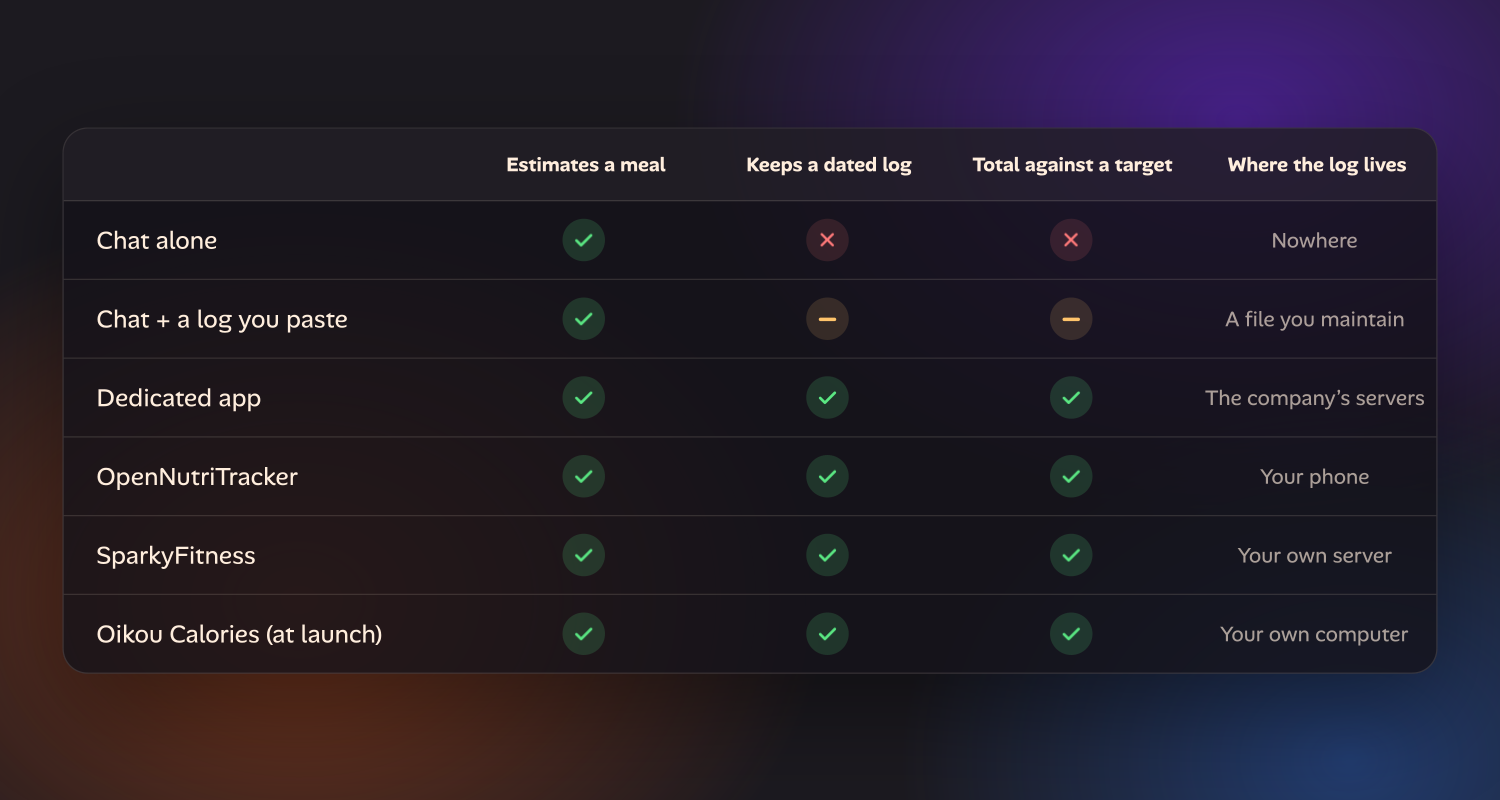
Every option below pairs an estimate with something that keeps the log. They differ in who keeps it and what it costs you.
A dedicated app
MyFitnessPal, Cronometer, Lose It! and the newer photo-first apps do the whole job: a food database, barcode scanning, a daily total, a target and charts. Their numbers for packaged and common foods come from a database, not from a model’s guess, and that is a real advantage. Several have a free tier that is enough for basic logging.
The catch: the better features usually sit behind a subscription, and your food history lives on the company’s servers. Check that you can export it.
Choose this if you want it to work today with no setup. For most people this is still the right answer.
A dedicated app inside ChatGPT
On January 7, 2026, MyFitnessPal launched an app in ChatGPT Health. Ask ChatGPT a nutrition question and it can answer with MyFitnessPal’s recipes, macro guidance and a calorie target worked out from your details.
At launch it answered questions. It did not write to your MyFitnessPal diary: the announcement described connecting your account and logging meals in plain language as something a future version could do. Check what it does now before you count on it.
The catch: this is the app and the chat working together, not the chat replacing the app. The log is still MyFitnessPal’s to keep.
Choose this if you already use the app and want to ask questions about food in the place you already ask everything else.
An open-source tracker
Two are worth knowing, and they are quite different.
OpenNutriTracker is a free app for Android and iOS, under the GPL v3 licence. There is no account. Your diary is stored encrypted on your phone, food data comes from Open Food Facts, USDA FoodData Central and the German BLS database, and you can export everything as JSON or CSV. It has an experimental AI meal assistant that can read a photo, which you switch on by entering your own API key from Anthropic, OpenAI or OpenRouter. An API key is billed by use and is separate from a ChatGPT or Claude subscription.
SparkyFitness is one you host yourself with Docker, with a web app and iOS and Android apps. It tracks food, exercise and body measurements, and has an AI chatbot that logs food from a message or a photo. Three things to know: the chatbot and family sharing are marked as beta, the project warns that releases can include breaking changes, and its licence is non-commercial, which its README describes as source-available and not open source.
The catch: OpenNutriTracker keeps data on one phone, so backing it up is your job. SparkyFitness needs a server and someone to run it.
Choose this if you want the log in your own hands and are comfortable with a little setup.
Oikou’s Calories app
This is ours, so weigh it accordingly. Oikou is a set of open-source web apps that run on a Mac or Linux computer you own. Oikou Host, the software that runs them, is free to run yourself, and the Catalogue at launch includes Calories, and two things about it are relevant here.
The log stays on your own computer. Not in a chat history and not on our servers. The AI part runs on the Claude or ChatGPT plan you already pay for, within that plan’s usage limits, so there is no second AI subscription.
The target moves with your training. Calories connects to Training, Oikou’s workout log, through a connection you approve. Log a session in Training and the day’s target in Calories changes to match. That is how Oikou’s apps share what they know, and it’s the reason to keep both logs in one place.
The catch: Calories is part of the Catalogue’s launch set, and Oikou needs a computer that stays on. If you want to count calories this week, use one of the options above.
Choose this if you’d like the log on your own machine and are willing to wait. The apps page lists the Catalogue’s launch set, and the page for people replacing subscriptions covers the other apps a chat plan can’t replace alone.
Which should you pick?
| If you want | Use |
|---|---|
| A rough number for one meal | A chat, with the prompts above |
| To count for a few days and see if it helps | A chat in a Project, with a log you paste into a file |
| To count for months with no setup | A dedicated app |
| The log on your own phone, free | OpenNutriTracker |
| The log on your own server, with an AI chatbot | SparkyFitness |
| The log on your own computer, tied to your workouts | Oikou’s Calories, at launch |
So, can ChatGPT or Claude replace a calorie counter? Not on its own. It replaces the typing and the looking-up, and it is good at that. It doesn’t replace the log, the total or the target. Keep those in something built to hold them, and let the chat do the estimating.
Whatever you pick, a calorie count is an estimate at every step, including the labels. Treat the numbers as a guide, and get advice from a doctor or a registered dietitian for anything that affects your health.
Questions
- Can ChatGPT or Claude replace a calorie-counting app?
- Not on its own. A chat can estimate a meal from a description or a photo, but it doesn't keep a reliable daily log, a running total or a target, and photo estimates can be far off. What works is an app that keeps the log, with an AI doing the tedious part.
- How accurate is ChatGPT at counting calories?
- It depends on what you give it. In a 2025 study of 195 dishes in the journal Nutrients, ChatGPT-5 was off by about 31% on average from a photo alone, and by about 14% when the photo came with a detailed ingredient list. Other studies found chat models identify foods well and underestimate large portions.
- Can I track calories with ChatGPT or Claude?
- For a few days, yes. Put your instructions in a Project, log each meal in one conversation and ask for the day's table after each entry. It breaks over weeks: long conversations lose early entries, a new chat starts without your totals, and nothing shows you a trend.
- Can ChatGPT replace MyFitnessPal?
- No, and MyFitnessPal's own app inside ChatGPT is a sign of that. It launched in January 2026 and answers nutrition questions with recipes, macro guidance and calorie targets. The log of what you ate is still kept by an app, not by the chat.
- Is there an open-source calorie tracker?
- Yes. OpenNutriTracker is a GPL-licensed app for Android and iOS that keeps your diary on your phone with no account. SparkyFitness is self-hosted with Docker and has web and mobile apps, though its licence is non-commercial, which its own README calls source-available rather than open source.
- What is the best prompt for estimating calories with AI?
- Give amounts, the cooking method and the fat used, and ask for a per-ingredient table with a low-to-high range and the assumptions behind it. With a photo, add the ingredient list and something for scale. The more the model is told, the less it has to guess.